
I once spent the best part of twenty minutes standing outside Bath Abbey, waiting for people to get out of my photograph.
Now, before that makes me sound like a thoroughly miserable individual who believes popular tourist attractions should be cleared of visitors whenever I arrive with a camera, let me explain.
Bath Abbey is a magnificent building. The architecture is extraordinary, and I wanted to capture as much of it as possible, allowing all those wonderful details to take centre stage. Unfortunately, several other people had apparently decided that Bath Abbey was worth visiting that day too. How inconsiderate of them.

I waited patiently as people wandered across the square, stopped to admire the building, took photographs of their own and generally went about enjoying themselves. Every time I thought a little space was about to open up, somebody else would appear. I moved around, reconsidered my composition and waited some more. At one point, a tour guide seemed to have taken up permanent residence in precisely the area I needed to be clear. There was plenty of space elsewhere, but apparently that particular spot was especially appealing. Eventually, after around twenty minutes, I politely asked him if he wouldn't mind moving.
Even then, I didn't quite get the photograph I'd originally imagined. I ended up sacrificing a little of the bottom of the building in the final composition to eliminate the remaining people. Not ideal, particularly when the whole reason for being there was to celebrate the architecture, but sometimes you have to decide which compromise bothers you least.
I came away with a photograph I was happy with, although probably not quite as happy as the people who were finally free to wander around without a photographer silently willing them to disappear.
It wasn't the first time I'd waited for people to leave a scene, and I very much doubt it will be the last.
It's Not That I Don't Like People
I should probably make that clear before I go any further.
I appreciate good portrait photography, and I've seen some remarkable examples of street photography where a fleeting human moment transforms an otherwise ordinary scene into something extraordinary. There are photographers who have an incredible ability to connect with strangers, anticipate expressions or capture those tiny interactions that tell us something about everyday life. I admire that skill, even if I've never felt particularly drawn towards developing it myself.
For me, photographing people introduces a whole collection of considerations that I'd rather not have occupying my mind when I'm out with a camera.
With portrait photography, there's the business of directing somebody, making them feel comfortable, thinking about what they want from the photograph and whether you're capturing them in a way they'll appreciate. There's a responsibility involved, and rightly so. Even candid photography brings its own questions. Is somebody going to notice the camera? Will they feel uncomfortable? Might they object to being photographed? Am I intruding on a moment that really doesn't belong to me?
I know there are photographers who thrive on those interactions. Some actively enjoy meeting strangers and discovering their stories. Others are happiest quietly observing human behaviour and waiting for something interesting to unfold.
I tend to be happiest when I can wander off and concentrate on a building, a landscape, a stretch of coastline or a particularly interesting piece of light without having to consider whether somebody is about to ask me why I'm pointing a camera in their direction.
Photography, for me, has always been closely connected with freedom. The freedom to explore somewhere unfamiliar, follow my curiosity, change direction halfway through an outing or spend far too long investigating something that most people would probably walk straight past. I can spend an hour photographing a location, come away with nothing particularly exciting and still feel that I've enjoyed the experience.
A building doesn't become self-conscious when I raise the camera. A pier doesn't ask whether I've captured its best side. And I've yet to encounter a tree that wants to inspect the photographs before I leave.
Although, given my experience at Bath Abbey, I wouldn't rule anything out.
The Places That Hold My Attention
Looking back across my photography, I can see how consistently I've been drawn towards places and the details within them. Coastlines, architecture, quiet woodland, illuminated streets, reflections, industrial structures, open landscapes and those little corners of the world where light and atmosphere suddenly make something ordinary feel rather special.
They're enormously different subjects, but the enjoyment I get from photographing them is remarkably similar.
I love the process of discovering a composition. Sometimes I arrive somewhere with a particular image in mind, while on other occasions I simply start walking and see what catches my attention. A change in the light might transform a building I've already passed three times. A reflection might reveal something I'd missed completely. Occasionally, a photograph presents itself almost immediately, while others require a little patience, a different viewpoint or the willingness to admit that the idea simply isn't working.
What I particularly enjoy is that the subject doesn't need anything from me. I don't have to arrange it, entertain it or explain what I'm trying to achieve. I can concentrate entirely on what I'm seeing and how I want to interpret it.
Of course, photographing places is hardly free from frustration. The weather rarely consults my plans, the sun has an annoying habit of disappearing behind a cloud at precisely the wrong moment, and the general public remains stubbornly unwilling to organise its movements around my compositions. But those are challenges I enjoy working around, even if my patience occasionally wears a little thin.
And somewhere along the way, I've realised that the absence of people isn't always simply about making a cleaner photograph. Sometimes it changes the way the photograph can be experienced.
Leaving Room for Someone Else
One of the photographs that illustrates this beautifully for me is Autumn Stillness, from my Serene Spaces collection.
It's a wonderfully peaceful scene, with golden autumn foliage surrounding a quiet stretch of water and an empty bench beneath the trees. There's nothing particularly dramatic happening. No spectacular action, no extraordinary event, no person doing something that demands our attention. Just a beautiful place, a lovely atmosphere and somewhere to sit.
And that's precisely what I love about it.
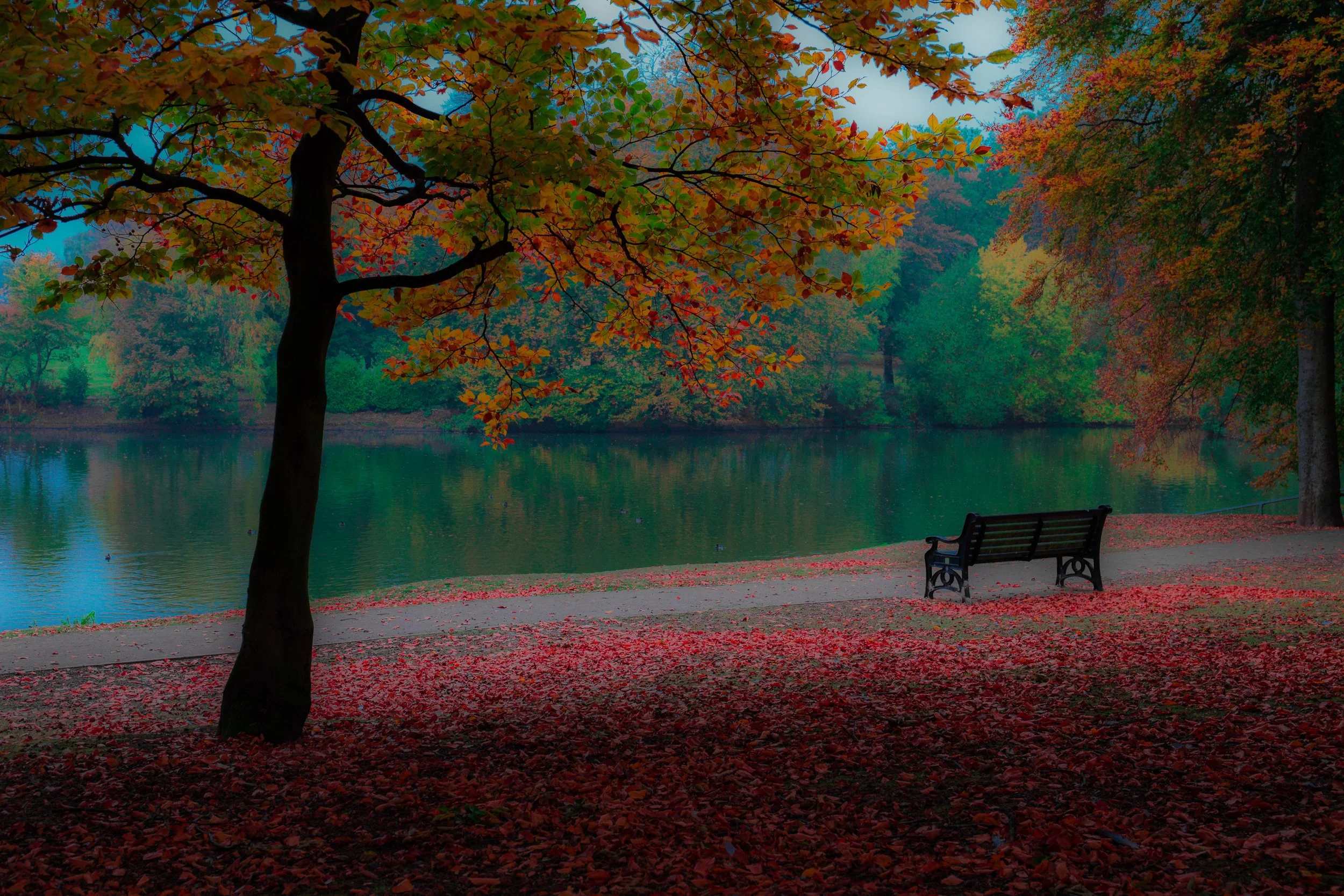
When I look at that photograph, I can imagine sitting on the bench, watching the water and enjoying the colours of autumn. Perhaps there's a little breeze moving through the trees, or the occasional sound of a bird somewhere nearby. It's the sort of place where I could happily spend half an hour doing very little, which is sometimes exactly what I want.
But here's the interesting thing. Somebody else looking at that photograph might imagine something entirely different. They might be reminded of a favourite park, a particular afternoon, somebody they used to visit places like that with, or simply the pleasure of escaping a busy day for a while.
The bench is empty, and that leaves the experience open to them.
Put somebody on that bench and the photograph changes. We might wonder who they are, what they're thinking about or why they're sitting there. Their presence becomes part of the story, perhaps even the most important part.
Without them, we're free to imagine ourselves taking their place.
I find that rather wonderful, particularly when I think about photography as something that eventually lives beyond my camera and my computer screen. If a photograph is hanging on somebody's wall, I'd love it to offer more than a reminder of somewhere I've visited. I'd like it to give them a place they can return to in their imagination, even if only for a few moments.
An empty pier can invite somebody to imagine walking towards the sea. A quiet street might remind them of wandering through a city after dark. A deserted stretch of coastline can evoke that lovely feeling of having an enormous landscape almost entirely to yourself.
I don't think every photograph needs to tell the viewer exactly what to feel. Sometimes it's better to leave a little room for them to bring something of their own.
When People Make the Photograph
Of course, having spent several paragraphs explaining why I generally prefer people to stay out of my compositions, it would be rather dishonest to pretend that their presence never improves a photograph.
Sometimes it does. Sometimes it makes all the difference - Shattered Peace is a particularly good example.
It's an autumn lakeside scene, but unlike the quiet invitation of Autumn Stillness, there's a sudden interruption. Birds are taking flight, scattering across the scene and breaking the calm, while a solitary figure remains at the centre of it all.
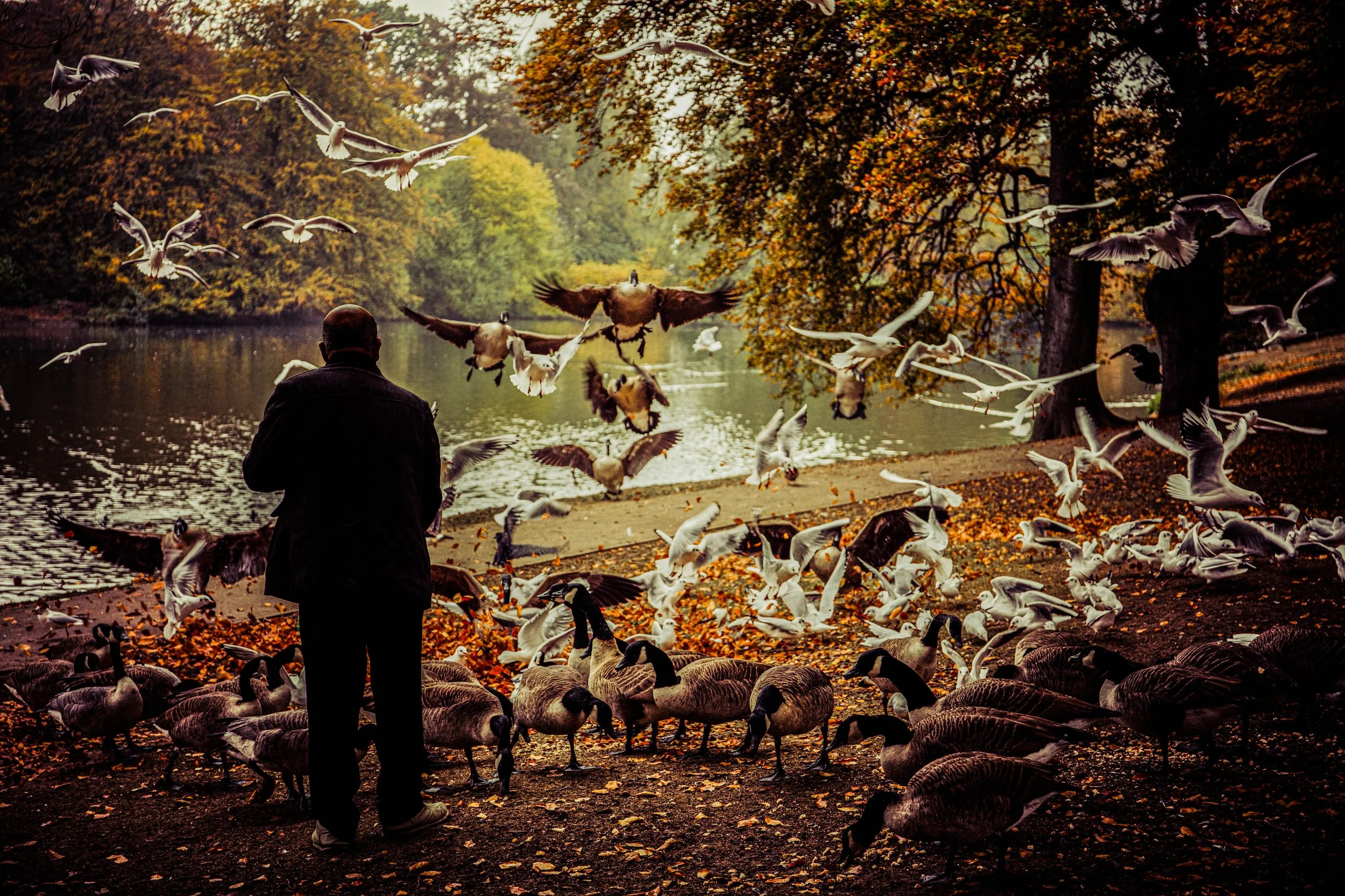
What appeals to me about that photograph is the contrast. There's the stillness of the person and the sudden movement of the birds, the peaceful setting and the unexpected burst of activity. The human figure gives us something to connect with, a point of calm against everything happening around them.
Take that person away and the photograph would tell a different story. The birds would still be interesting, the setting would still be attractive, but that wonderful relationship between stillness and movement would be diminished.
It's a reminder that photography isn't particularly interested in following the rules we invent for ourselves.
I might generally prefer photographing places without people, but that doesn't mean I'm going to ignore a scene where somebody's presence makes it stronger. Equally, I wouldn't want to remove a person simply because I've decided that empty scenes are somehow more artistic.
The question is always whether their presence contributes to the photograph I'm trying to make.
In Shattered Peace, it absolutely does. At Bath Abbey, however, I remain unconvinced that the tour guide was making a valuable artistic contribution.
And then, of course, there's JOY. Perhaps the greatest irony of my photographic career is that one of my most recognisable and significant photographs is entirely centred around people. For someone who has spent an extraordinary amount of time waiting for strangers to get out of his compositions, that hasn't escaped my attention.
But there's a difference. Nobody in JOY was posing for me, nobody needed directing, and none of them had any idea they were being photographed. I wasn't trying to arrange a moment or persuade somebody to behave in a particular way. I was simply observing something that was already happening, and recognising that it was worth capturing.
Which perhaps proves that I don't have an objection to photographing people after all. I just prefer it when they get on with whatever they're doing and leave me to get on with whatever I'm doing. Although, judging by my experience outside Bath Abbey, that arrangement doesn't always work quite as smoothly as I'd like.
A Different Kind of Connection
I sometimes wonder whether my preference for photographing places rather than people is connected to how I first became interested in photography. It all began with a little ladybird in my parents' garden, photographed with a Canon compact camera I'd been given for Christmas. From there came insects, flowers, raindrops, wildlife and countless visits to places where I could simply wander around looking for something interesting. There was no particular plan behind any of it, and certainly no ambition to become a particular type of photographer. I just enjoyed discovering things, trying to capture them and sharing what I'd seen with others. The pleasure came from noticing something that caught my attention, spending time exploring it through the camera and hopefully coming away with a photograph that allowed somebody else to appreciate it too. Looking back, I think those early experiences established much of what I still enjoy about photography today.
Over the years, the subjects have changed enormously, as has the way I approach them, but that original curiosity has remained remarkably consistent. I'm still drawn towards places, details, light and atmosphere, and I still get a tremendous amount of satisfaction from discovering something unexpected or coming home with a photograph that captures what made a particular location feel special to me. Perhaps that's why photographing people has never become a significant part of my work. It isn't something I've consciously rejected, and I certainly don't consider it any less interesting or worthwhile; it's simply that my curiosity has always taken me elsewhere, and I've become increasingly comfortable with that. There was a time when I probably felt that developing as a photographer meant experimenting with every possible subject, technique and genre, but these days I think there's just as much value in recognising what genuinely interests you and allowing yourself to explore it more deeply. After all, I don't need to photograph everything to enjoy being a photographer.
The People Who Aren't There
There's a slightly amusing contradiction in all of this, which I hadn't really considered until I started thinking about the subject more carefully. I spend quite a lot of time trying to keep people out of my photographs, yet much of what I hope those photographs eventually achieve depends entirely on people looking at them and finding something they connect with. Whether that's a place they've visited, a memory of somewhere special or simply a scene they'd love to experience for themselves, the photograph becomes something quite different once it leaves my camera and finds its way into somebody else's life.
I think that's part of what attracts me to photographing places without people in them. I can enjoy the experience of discovering somewhere, finding a composition and capturing what made it special to me, but the finished photograph doesn't have to remain tied to my own experience. An empty bench, a quiet pathway or a deserted pier can mean entirely different things to different people, and I rather like the idea that somebody might look at one of my photographs and imagine themselves there. It doesn't need to be the same experience I had, and in many ways I'd prefer it wasn't. That's part of the pleasure of creating something and allowing other people to make their own connection with it.
Of course, there will always be exceptions, and I wouldn't want to become so attached to the idea of empty scenes that I missed something wonderful happening right in front of me. Shattered Peace and JOY are reminders of that, particularly the latter, given that one of my most recognisable photographs happens to be centred entirely around people. I suspect I'll continue to photograph whatever genuinely catches my attention, whether that's a magnificent building, an atmospheric coastline or an unexpected human moment. The important thing is that I'm responding to what interests me rather than trying to follow a particular set of rules about what should or shouldn't appear in the frame.
Having said all that, I very much doubt my habits are going to change dramatically. I'll still find myself waiting for somebody to finish taking a selfie, wandering around looking for a different viewpoint or standing patiently beside a camera hoping that a particularly determined tourist might eventually move along. And if you ever happen to spot me doing that, please don't take it personally. I'm sure you're a perfectly lovely person, and under different circumstances I'd probably be more than happy to stop and have a chat. It's just that, at that particular moment, there's a rather beautiful building behind you that I'm desperately trying to photograph.